Flipping the Idea of Civilization
the False Arc of Progress
Oct 21, 2025
By: Michiel Knoppert

How Civilization Learned to Spend More Energy for Less Wellbeing
This article is part of the wider exploration of the Uncivilize framework, which maps four modes of human living: Global, Local, Domestic, and Wild. Each mode operates with a different energy demand, lifestyle, and economy, and each is conducive to different kinds of wellbeing.
You might assume that modes with higher energy use generate more wellbeing — that more energy means more control, more comfort, more material abundance end thus more wellbeing and happiness. But as energy use rises, our sense of balance, connection, and contentment often falls. The Uncivilize framework helps explain why — and how lower-energy modes generate more human and planetary wellbeing at a much lower impact, while Global Mode burns through extraordinary power while struggling to deliver either.
This article traces that paradox and asks a simple question with radical consequences:
What if progress is not about how much energy we have available for growth, but rather about how we can optimize broad wellbeing for the energy we spend?
Energy Use per Mode
Energy is more than fuel — it’s a proxy for everything we produce, consume, and discard. Every extra joule burned increases material wealth, but also our impact. We use the energy footprint for each mode as a proxy for both material wealth and impact.
Wild Mode (hunter-gatherer) operates almost entirely on human metabolic energy — around 5 megajoules per person per day. Energy comes from food, fire, and movement. Life is immediate, circular, and self-sustaining. Waste is minimal, cycles are seasonal, and the ecosystem itself is the battery.
In Domestic Mode (pastoral and horticultural), humans draw power from domesticated animals, simple tools, and small-scale cultivation — about 20 MJ/day per person. Energy use rose alongside stored abundance: dried food, woven goods, community care. People are less wild, but still deeply embedded in natural rhythms.
Local Mode (agricultural) multiplies energy through wind, water, and biomass — roughly 50 MJ/day. Surpluses built cities and hierarchies. The human body becomes a tool of production. More food, more control — but also fatigue, disease, and inequality.
In Global Mode (industrial), energy use explodes: from 200 to over 500 MJ/day per person in wealthy nations. Fossil fuels and machines replace muscles. Humanity gains speed, comfort, and power — yet finds itself spiritually and socially unmoored.
Wellbeing per Mode
If human history is the story of mastering nature, then wellbeing tells its counterstory — one of diminishing connection.
In Wild Mode, people live with little material wealth yet show extraordinary subjective wellbeing: emotional equilibrium, social intimacy, and spiritual rootedness in a living landscape. Research by Marshall Sahlins and Victoria Reyes-García confirms this: satisfaction arises when social and ecological needs align, not when material abundance peaks.
Domestic Mode revolves around family, herds, and gardens. Purpose is embedded in daily acts of care, with ritual and reciprocity anchoring meaning. Wellbeing remains high, though vulnerability to conflict and environment grow.
Local Mode marks a turning point. Stability comes with hierarchy and heavier labor. While intellectual and financial life expands for some, social and emotional wellbeing decline for most — a pattern evident in historical demography and ethnographic comparison.
In Global Mode, material wealth and medical progress soar. People live longer, safer lives — yet often lonelier and more anxious ones, prone to diseases of affluence. Despite unprecedented prosperity, happiness surveys plateau. As Easterlin, Diener, and Helliwell show, the link between income and happiness weakens once basic needs are met, and as E.F. Schumacher warned, efficiency and comfort can erode vitality, community, and a sense of enough.
The Math of Wellbeing
We see Global Mode score higher on objective wellbeing; material wealth, security, and health — though even these are starting to erode — but far lower on subjective wellbeing; belonging, purpose, and meaning.
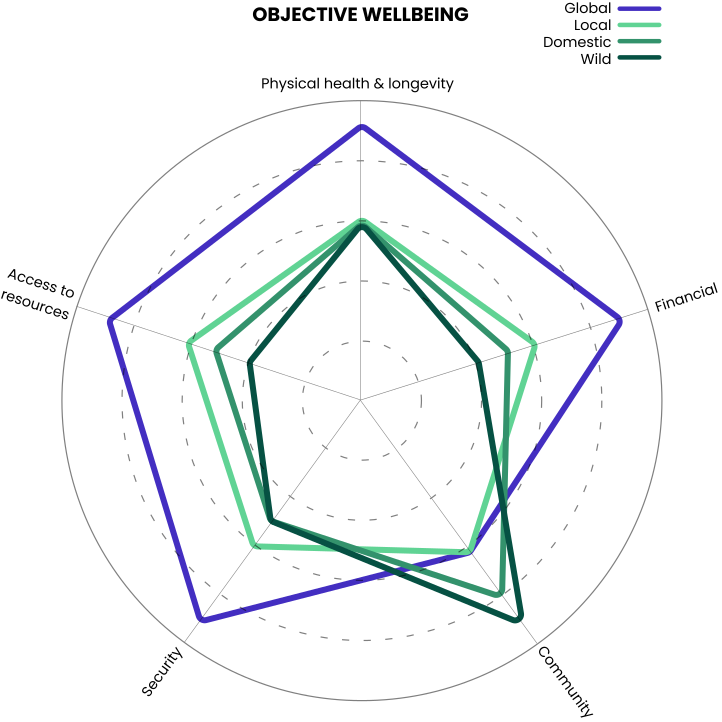
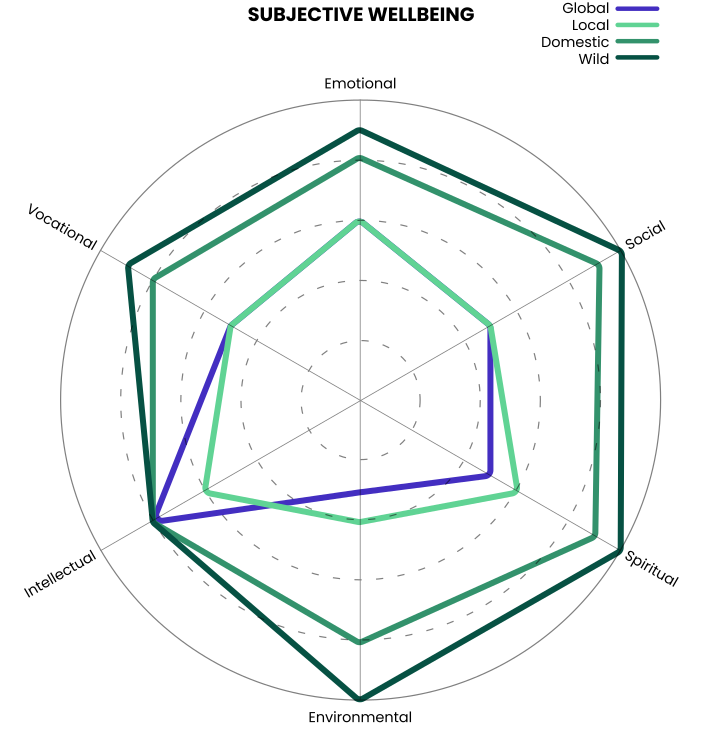
We created a compounded index that combines subjective and objective wellbeing and use it as a measure for the wellbeing and happiness that people experience in each mode. If we divide that wellbeing by energy use — wellbeing per joule — the results are stark. In Wild Mode, people used 5 MJ/day and achieved near-optimal life satisfaction. While in Global Mode, people burn 500 MJ/day and fail to reach the same state of happiness.
By this metric, Wild Mode is over 100 times more effective at producing wellbeing than Global Mode.
Mode | Compounded Wellbeing Index (0–5) | Energy use MJ/day | Wellbeing efficiency |
|---|---|---|---|
Wild | 4.3 | 5MJ/day | 86 |
Domestic | 3.9 | 20MJ/day | 19.5 |
Local | 3.0 | 50MJ/day | 3.75 |
Global | 3.3 | 500MJ/day | 0.66 |
But it’s not just about using less energy or wellbeing rating — it’s about the kind of wellbeing produced.
Industrial society excels at financial and physical security but at the cost of emotional, social, and ecological health. Earlier modes cultivated a broader, more balanced wellbeing — rooted in belonging, rhythm, and reciprocity rather than accumulation.
Rethinking Progress
Enlightenment thought imagined history as a staircase — every generation a step higher toward freedom and prosperity. But perhaps we’re running up an escalator going the other way. What little we gain in material wealth, we lose in collective wellbeing — and at a mounting ecological cost.
If we judge civilization not by GDP but by how much life we experience per unit of energy, the pattern reverses. The most “primitive” ways of living turn out to be the most wellbeing-efficient.
This is not a call to return to the wild, but to relearn what the wild knew:
that wellbeing grows from enoughness, not excess.
Each mode — Wild, Domestic, Local, Global — carries a fragment of the whole. Together, they hold the blueprint for a broader wellbeing.
The task ahead is not to add more energy, but to reinvest it differently —
from control to connection, from productivity to presence, from progress to participation.
Civilization’s success should not be measured by how much energy it can burn,
but by how much joy it can generate.
Sources
1 Wild Mode — Human–Nature Connection & Low-Energy Abundance
Wellbeing
Reyes-García, V. et al. (2021). PLoS ONE — High SWB in indigenous societies.
Galbraith, E. et al. (2024). PNAS — “Remarkably high” wellbeing in 19 small-scale societies.
Capaldi, Passmore et al. (2015). Frontiers in Psychology — Nature connectedness improves wellbeing.
Li, Q. (2018). Forest Bathing — Immune and stress regulation via nature exposure.
Lowry, C. et al. (2007). Neuroscience — Soil microbes boost serotonin.
Kuo, M. (2015). Ecopsychology — Cognitive and immune benefits from green space.
Energy & Ecology
Smil, V. (2017). Energy and Civilization — Forager energy ~4–5 MJ/day.
Pontzer, H. (2021). Burn — Constrained metabolism, low energy throughput.
Gowdy, J. (1998). Human Ecology — Abundance from reciprocity and leisure, not material scale.
Philosophy / Foundations
Sahlins, M. (1972). “The Original Affluent Society.”
Kaplan, D. (2000). Critique — Mortality and risk as counterbalance.
2 Domestic Mode — Skill, Kinship & Embodied Purpose
Wellbeing
Buettner, D. (2012). The Blue Zones — Household labour, food culture, longevity.
Keinan & Kivetz (2011). JCR — Psychological reward from skilled making.
Wingeier-Werneke (2020). Journal of Physical Activity — Light daily work → mortality reduction.
Energy
Murdoch, J. (2000). Ecology of Agrarian Change — ~20–40 MJ/day incl. animal labor.
Scott, J.C. (2017). Against the Grain — Stored surpluses + vulnerability.
Philosophy / Foundations
Illich, I. (1973). Tools for Conviviality — Skill-centered freedom.
Illich, I. (1981). Shadow Work — Deskilling under industrial institutions.
3 Local Mode — Agrarian Hierarchy & Social Stress
Wellbeing
Holt-Lunstad, J. et al. (2010). PLoS Medicine — Social ties increase life expectancy.
Valtorta, N. et al. (2016). Heart — Isolation → cardiovascular risk.
Haslam, S. (2018). The Social Cure — Identity + community → better health.
Energy
Wrigley, E.A. (2010). Energy and the English Industrial Revolution — Biomass ceiling ~50–100 MJ/day.
Fischer-Kowalski, M. (1997). J. Industrial Ecology — Material throughput rises with stratification.
Philosophy / Warnings
Scott, J.C. (2020). State formation → coercive labor expansions.
4 Global Mode — High Energy, Low Connection
Wellbeing
World Happiness Report (2024) — Gains plateau in wealthy nations.
Cacioppo, J. (2018). Loneliness — Social disconnection as public health threat.
Arendt, H. (1958). The Human Condition — Loss of active life through automation.
Energy
IEA Global Energy Review (2023) — 200–500+ MJ/day in rich countries.
Smil, V. (2019). Growth — Fossil energy → exponential consumption.
Risks
Bratman, G. et al. (2019). Nature Sustainability — Environmental decoupling harms cognition.
Louv, R. (2005). Last Child in the Woods — Nature-deficit disorder.
5 Cross-Mode: Energy vs. Wellbeing Efficiency
Empirical Comparisons
Lambert et al. (2020). Nature Energy — Wellbeing plateaus once basic energy is met.
Steinberger, J. et al. (2020). Global Environmental Change — Excess energy does not improve wellbeing.
Brand-Correa & Steinberger (2017). Ecological Economics — Energy–Wellbeing Efficiency framework.
Haberl, H. et al. (2011). Socio-metabolic Transitions — Forager → Agrarian → Industrial energy jumps.
Kummel & Lindenberger (2014). Energy and Economic Growth — GDP tied to energy, not to happiness.
Work, meaning & economic structure
Suzman, J. (2020). Work: A Deep History… — Work changes meaning as society industrializes.
Modernity debates
Easterlin & critics — Income vs. happiness: rising energy ≠ rising wellbeing.
Pinker, S. (2018). Enlightenment Now — Use as counterpoint (health/security gains acknowledged).