Braiding Economies
A Framework for a Living, Hybrid Future
Oct 16, 2025
By: Michiel Knoppert

What if what we think of as 'the economy' is only one layer of a much larger, older, and more human system?
This article is part of the wider exploration of the Uncivilize framework, which describes four intertwined economies — Global, Local, Domestic, and Wild. Each mode has its own logic of value, scale of exchange, and way of sustaining life. Together, they reveal that what we call the economy is not a single machine but a stacked, living braid.
We’ve been told there’s just one economy — the global one. It’s the world of GDPs, stock markets, global supply chains, and quarterly growth. But the global economy is only one layer of a much older and richer web of exchange. Beneath it, three other economies continue to live and breathe: the local, the domestic, and the wild. Currently the Global economy dominates the others through various types of exploitation and displacement.
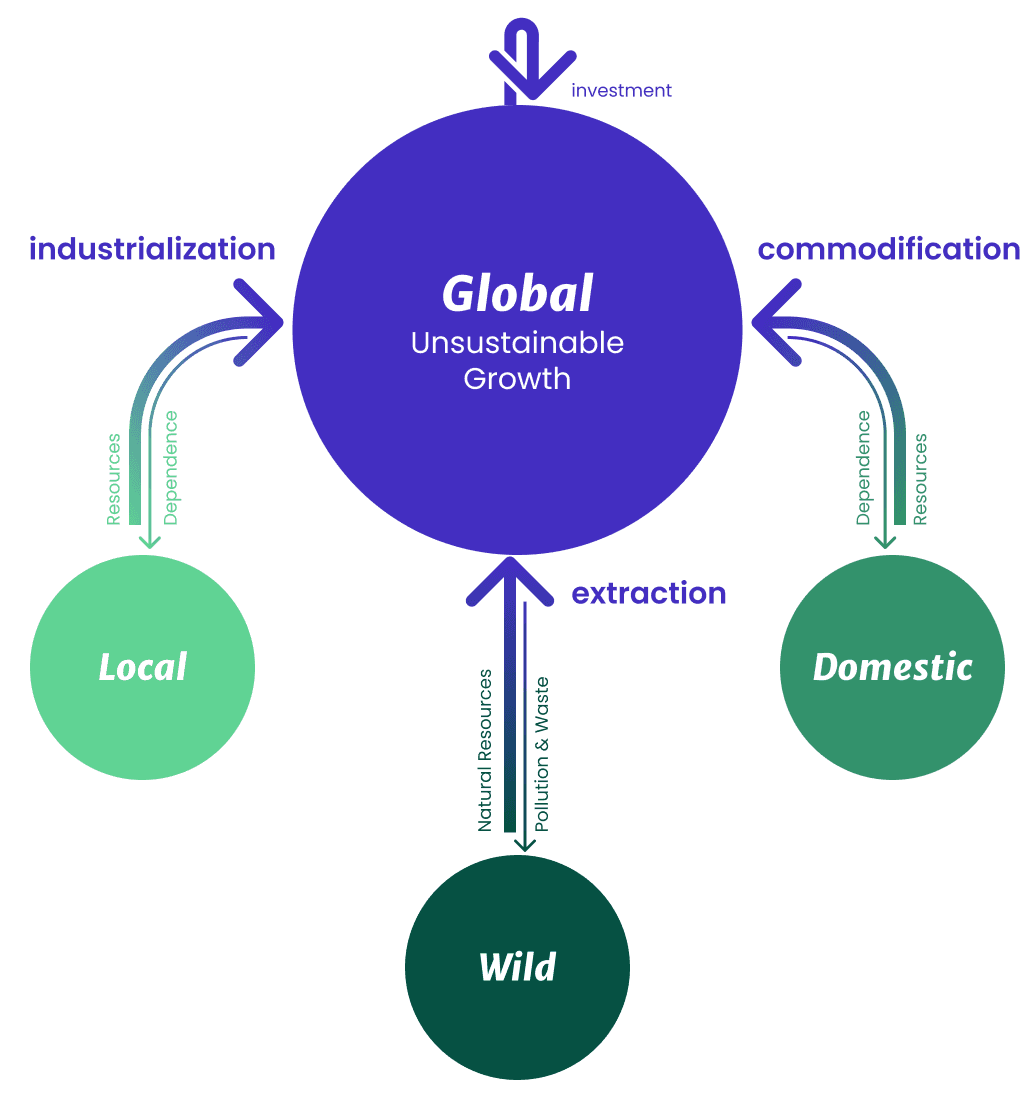
At Uncivilize, we don’t reject the global system — we reframe it. We see it as one layer in a braided stack of economies, each with its own platform of exchange, reach, and type of value. Together, they form a hybrid system — one that can heal the disconnection between people, community, and planet.
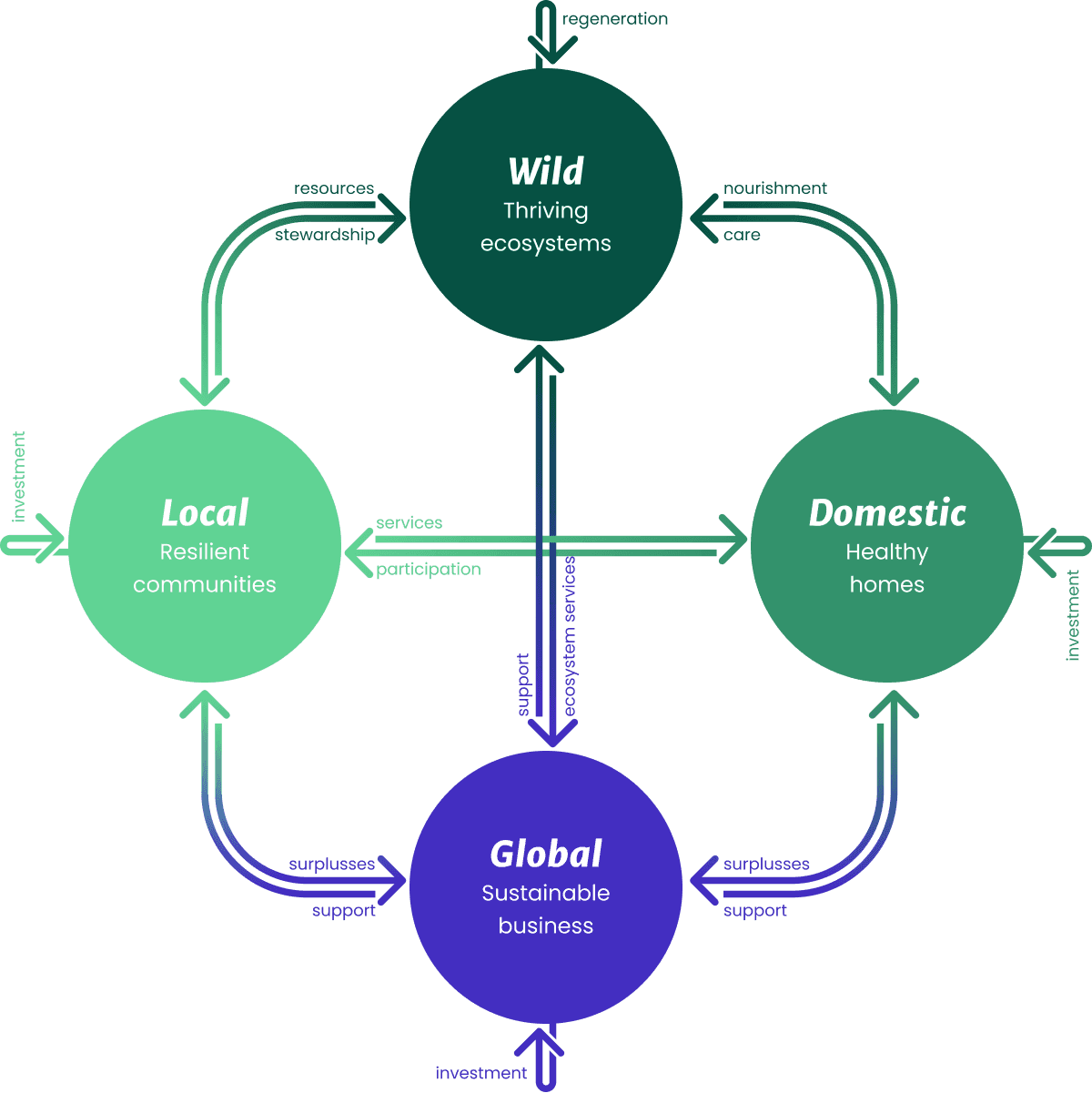
This article explores how these four economies interact, where the global system has drifted out of balance, and what becomes possible when we reconnect the layers rather than replace them.
The Global Economy — The Disembedded Platform
The global economy runs on formal, transactional exchange. It uses universal tokens (money) and enforces contracts through law rather than trust. This disembedded platform allows trade between strangers, making planetary coordination possible — shipping containers, digital standards, global research networks.
It’s powerful, but it’s floating. Because it’s disembedded from community, people and ecology, it tends to treat them as inputs to be optimized rather than partners to be cared for. This is the core design flaw: global efficiency built on invisible subsidies — cheap energy, externalized waste, and borrowed time.
The insight isn’t to shut it down. It’s to rethink and reconnect it — to make the global layer serve the others. The global mode is best when it acts as an infrastructure of support: providing open standards, global safety nets, and shared knowledge — instead of extracting for endless growth.
The Local Economy — The Middle Tissue
The local economy is where exchange re-embeds itself in place. It’s the scale of towns, cooperatives, and bioregions — where people trade in kind, in trust, or with local currencies. A local energy community, peer-to-peer insurance, a municipal repair workshop — these are not micro versions of the global economy, they are different species of economy entirely.
The local mode’s platform of exchange is trust and visibility — not abstraction. It anchors value in relationships, not market logic.
Where the global seeks efficiency through scale, the local achieves resilience through diversity. It can’t compete on price, but it can on true-cost efficiency — lower waste, stronger community health, and real belonging. Every euro spent locally circulates multiple times before it leaks out — multiplying value rather than extracting it.
The Domestic Economy — The Circle of Care and Craft
The domestic economy is the oldest and smallest scale — the household. Here, value circulates through care, maintenance, and trust. It’s where meals are cooked, gardens tended, and people healed. It’s where shadow work happens — the invisible labor that keeps life running: caregiving, cleaning, teaching, emotional support.
When this work becomes institutionalized in the global economy — as nursing, teaching, or repair services — it is systematically undervalued, because it doesn’t generate tradable profit. Yet it produces the conditions for all other economies to exist.
The domestic mode’s platform of exchange is trust and time — currencies that can’t be monetized but are profoundly productive. When households become places of creation instead of consumption, they regenerate skill, autonomy, and pride.
And when health becomes part of daily life — as seen in blue zones — healthcare shifts from repairing sickness to maintaining wellness. Studies in the Netherlands show that over 70% of chronic disease costs are preventable through lifestyle changes — diet, movement, stress reduction, and social ties. If we invest in the domestic economy, we don’t just heal individuals; we heal the system.
But the domestic economy is more than that. What we now consume, we once made — or our neighbors did.
The earliest commodities were not abstract services but things made at home: earthenware, furniture, food, and clothing. Only later did we outsource what we did: repair, care, education. In losing these acts, we lost the daily rhythm of creation — the quiet satisfaction of making something with our own hands.
By rekindling these skills, homes can become productive units once again — small-scale workshops of meaning and utility. A kitchen that preserves food, a shed that repairs furniture, a home studio that makes clothing or ceramics. These acts are not hobbies; they are foundations of autonomy. They trade convenience for capability, dependency for self-respect. And what is made here — like care, education, and repair — can be shared or traded within the circle of trust, creating local value that strengthens the household.
When the domestic economy thrives, it anchors the others. It lightens the load on the global, enlivens the local, and honors the wild. It is the seedbed of skill, health, and belonging — the place where the economy becomes personal again.
The Wild Economy — The Ground of All Value
Before there was trade, there was the wild: the original economy of life. In this mode, value is reciprocal — what you take, you return. Nature gives freely, but demands respect: clean water, fertile soil, breathable air.
The wild economy has no platform of exchange — its value is direct use and survival. You can’t buy a sunrise or patent a pollinator. But without them, all other economies collapse.
When the wild is degraded, healthcare costs rise, productivity falls, and well-being evaporates. In the Netherlands, air pollution alone causes around 9,000 premature deaths annually — the silent invoice of a disembedded economy. If we treated the wild as the foundational account, those costs would never be externalized.
The Braided Stack — A Hybrid Economic System
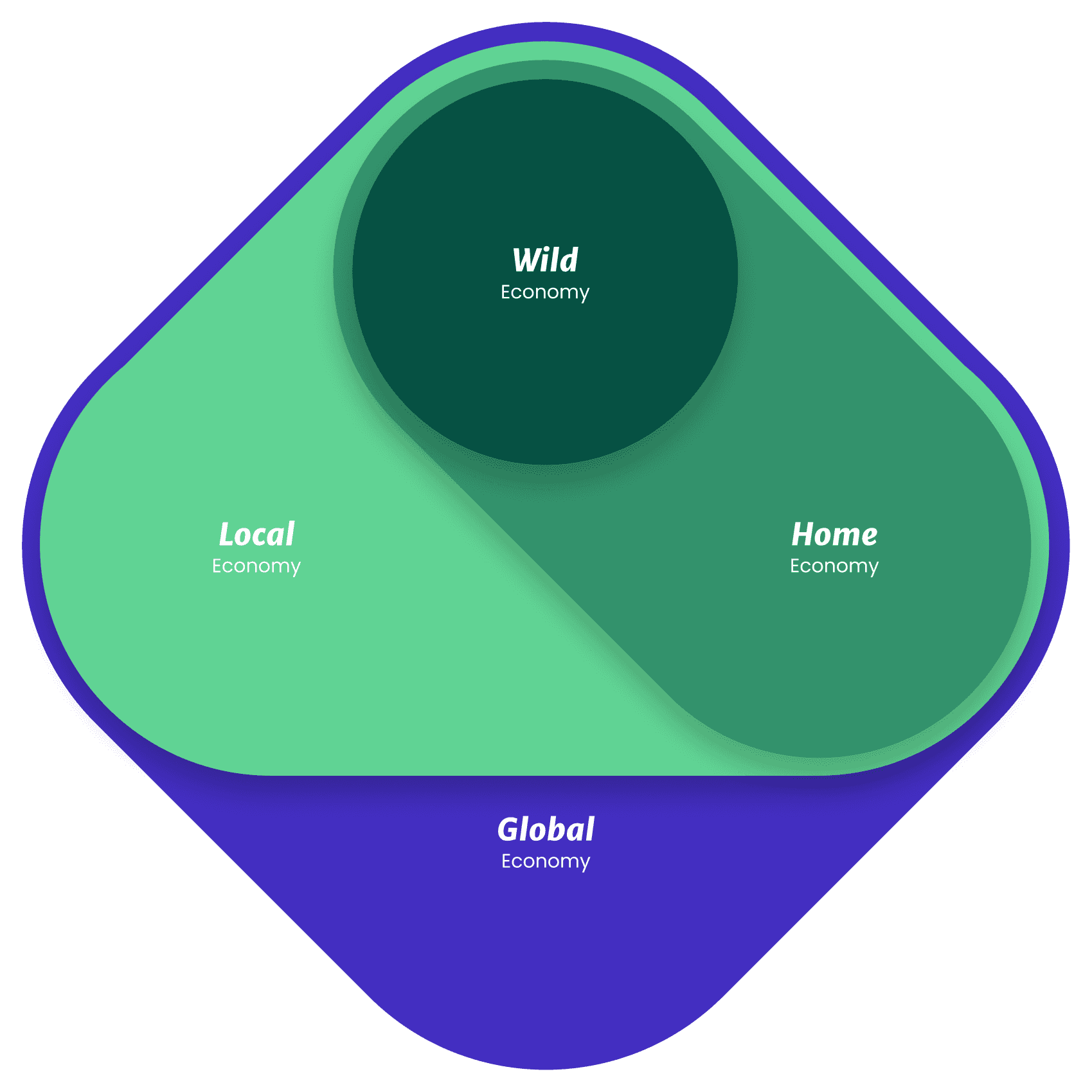
Each of these economies is not a replacement for another — it’s a layer. Each has its own platform of exchange and sphere of reach:
Mode | Platform | Currency | Reach | Relation |
|---|---|---|---|---|
Wild | Direct reciprocity | Regeneration | Only Wild | Base layer |
Domestic | Trust, care, time | Health, belonging | Domestic + Wild | Circle of care |
Local | Community networks | Reputation, mutual aid | Local + Domestic + Wild | Weaving of cooperation |
Global | Law, money, data | Efficiency, abstraction | All | Disembedded connector |
When these platforms interoperate, a new kind of value begins to flow — one that’s plural, resilient, and alive.
Example : Reimagining Healthcare Across the Four Economies
Let’s look at how this works in practice.
In the Global Economy, specialized hospitals and research institutes remain — but they transform into knowledge platforms. Academic hospitals share global data, develop best practices, and coordinate rare or high-tech care. The global insurance market evolves into a re-insurance platform for local insurance co-ops, a platform for coordination and knowledge sharing, not profit
In the Local Economy, care returns to neighborhoods. Community-owned clinics emerge — places where residents are both members and stewards. Local insurance co-ops pool “care capital,” and healthcare workers are embedded in the communities they serve. Local economies thrive through mutual visibility and shared responsibility — healthcare becomes a collective endeavor.
In the Domestic Economy, households and co-housing communities shift focus to preventative health.
Gardens, shared meals, intergenerational homes, physical work, emotional connection — the elements of “blue zones” — reduce demand for medical intervention. Every act of self-care, repair, and connection becomes a preventative investment in health. This alone could save tens of billions annually in chronic disease costs for the Netherlands.
In the Wild Economy, health means breathing clean air, drinking clean water, and living near green space.
Restoring wetlands, planting trees, cleaning rivers — these are healthcare measures too. If the wild flourishes, the body follows. We invest in the immune system of the planet — and it repays us in kind.
Together, these exchanges form a regenerative loop:
The wild provides the foundation.
The domestic regenerates health.
The local coordinates care and access.
The global connects and supports knowledge.
The Work of Uncivilize
At Uncivilize, our mission is to make this hybrid reality visible and actionable — to help people and organizations see where their energy flows, and where they can re-embed it.
We design tools that let people map their dependence on the disembedded global economy — and find pathways to strengthen the embedded ones.
We believe the future economy won’t be post-global, but post-extractive:
a web of exchanges where the global serves, the local roots, the domestic sustains, and the wild leads.
Because the economy is not a machine — it’s a living braid. And our work is to learn how to weave it again.
Sources
1 Economic Alternatives & Pluralistic Frameworks
These works justify the idea that multiple economies coexist and serve different human needs.
Elinor Ostrom, Governing the Commons — Validates community governance and collective ownership in Local/Wild economies
Kate Raworth, Doughnut Economics — Multi-boundary model linking environment & society (macro limits)
E. F. Schumacher, Small is Beautiful — Scale matters — reinforces Domestic & Local economy value
Karl Polanyi, The Great Transformation— Highlights non-market forms of exchange as foundational
Silke Helfrich, David Bollier, Free, Fair and Alive— Commons-based production & governance
Mariana Mazzucato, The Value of Everything— Revaluation of care, public and foundational economy
2 Wild Economy & Ecological Reciprocity
Grounds the claim that the natural world is an economy that predates civilization.
Robin Wall Kimmerer, Braiding Sweetgrass — Reciprocity with ecosystems as exchange
Fritjof Capra, The Hidden Connections — Systems theory: nature as metabolic economic network
Eduardo Kohn, How Forests Think — Non-human actors participate in economic relations
Catherine Schuppli, regenerative ecology journals, Ecosystem service valuation — Wild economy produces essential life-supporting value
3 Domestic Economies, Care, Household Production & Shadow Work
These sources support the Domestic Economy as a productive unit.
Ivan Illich, Tools for Conviviality — Autonomy-enhancing tools for domestic/household production
Silvia Federici, Re-enchanting the World — Feminist political economy, importance of unpaid care labo
Juliet Schor, Plenitude — Household/local production as a post-growth pathway
Saskia Sassen, Expulsions — How global finance extracts from homes & care systems
OECD / WHO studies, Lifestyle & chronic disease burden — Healthcare cost reduction via domestic well-being
Dan Buettner, Blue Zones research — Evidence that social & home-centered life drives longevity
4 Local Economies, Regional Stewardship & Commoning
Strengthens the argument for place-based production and exchange.
Jane Jacobs, The Economy of Cities — Innovation emerges locally, not globally
Michael Porter, Clusters & Regional Competitiveness research — Local specialization increases resilience
Transition Towns movement, Practical case studies — Local economic relocalization for climate & community
Community Wealth Building institutes, Policy support — Democratic ownership of local value
5 Global Economy & Industrial Platforms
Critique of over-scaling and extraction — necessary for contrast.
Jason Hickel, Less is More — Growth addiction vs. ecological boundaries
Naomi Klein, This Changes Everything — Industrial capitalism vs. climate
Joseph Stiglitz, Inequality & globalization research — Failure modes of disembedded markets
Thomas Piketty, Wealth concentration data — Power imbalance in global economy
6 Resilience, Risk Distribution & System Design
Supporting how braiding economies enhances resilience.
Nassim Taleb, Antifragile — Diversity & redundancy increase long-term survival
Buckminster Fuller, Operating Manual for Spaceship Earth — Synergy between human & ecological functions
Kris De Decker, Low-Tech Magazine — Human-scale energy & manufacturing
Michael Greer The Retro Future — Stepwise descent into more resilient modes
7 Anthropology & Deep History
Establishes that braided economic systems are humanity’s baseline.
David Graeber & David Wengrow, The Dawn of Everything — Societal fluidity & multi-mode coexistence
Marshall Sahlins, Stone Age Economics — Hunter-gatherer affluence — Wild Economy
James C. Scott, Against the Grain — The state does not precede the economy
Lewis Mumford, The Myth of the Machine — Tech scale vs. humane scale