Carbon neutral cheese
Idea: Rewetting and Rewilding Dutch Peatlands
Oct 8, 2025
By: Michiel Knoppert
For centuries, the Dutch landscape has been shaped by an uneasy truce with water. The low peatlands, once vast wetlands teeming with life, were drained beginning around the 11th century to make the soil arable. The newly exposed peat proved rich and fertile, perfect for grass, and therefore perfect for cows.
That decision transformed the Netherlands. Cheese, milk, and butter became cultural icons and economic engines. But there was a hidden cost: as the peat dried, it oxidized, releasing carbon into the air. Each hectare of drained peat continues to emit CO₂, sink lower, and demand more pumping, a slow-motion collapse beneath the foundations of the dairy economy.
Today, that tension runs deeper. Modern dairy practices not only stress the land but also the animals, while cheese itself — beloved and deeply woven into Dutch culture, carries a surprisingly heavy footprint. Per kilogram, it often emits more carbon than chicken meat. For myself, as a vegetarian who can’t imagine life without cheese this is a difficult truth.
So how can we keep our cheese — and our conscience? As climate and soil systems reach their limits, we propose a different kind of dairy: one that doesn’t fight water, but flows with it. Paludiland is a living, working landscape where rewetted peatlands, paludiculture, and craft-based economies come together to create food, materials, and meaning — and where even cheese can become carbon neutral.
From drained fields to living wetlands
In Paludiland, the starting point is simple: stop fighting water. Instead of trying to dry the land for conventional dairy cows, the landscape is rewetted, transforming from a carbon source into a carbon sink. The wet soils stop decomposing and start storing carbon again. The new ecosystem acts as a natural water buffer, filters nutrients, and provides habitat for countless plant and animal species.
This living infrastructure makes it possible to keep producing milk, but in a way that works with the natural landscape, not against it.
Rethinking the herd
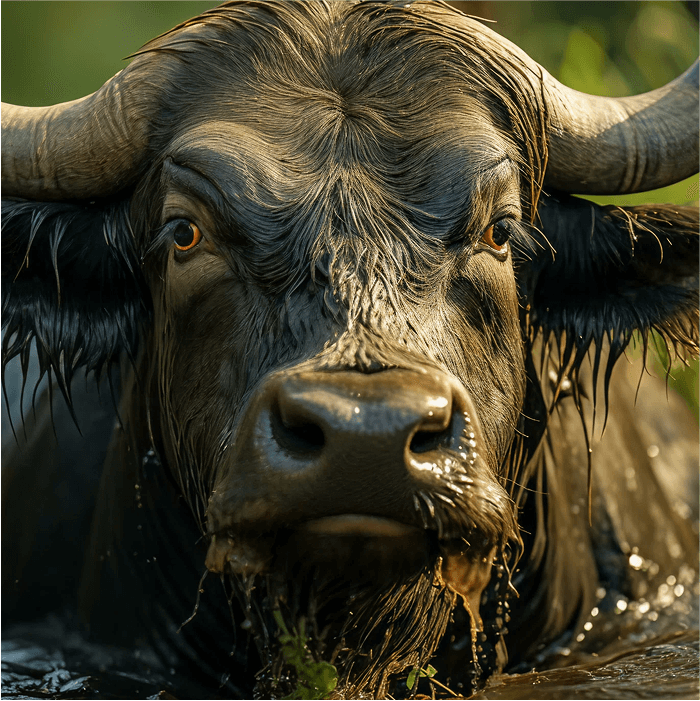
Instead of high-yield dairy cows that depend on drained, dry soil, Paludiland works with water buffalo and Blaarkoppen, two hardy breeds adapted to wetter conditions. They produce less milk, but of richer quality: perfect for mozzarella and traditional Dutch farmhouse cheeses.
Because these animals live outdoors all year, their manure and urine stay separate, minimizing methane and ammonia formation. Adding small amounts of local brown seaweed to their diet could reduce methane emissions by up to 50%, a natural adaptation that helps us move toward carbon neutral dairy.
The herds graze across a mosaic of wet meadows and reed beds, cared for by volunteers and professionals together. A mobile milking station follows them along raised paths — low-tech, flexible, and light on the land.
Four Modes, One Living Network
What makes Paludiland more than a farm is its structure. It’s not a single enterprise, but a network of interdependent initiatives spread out across Uncivilize's four modes, four layers that together form a regenerative social-ecological system. Each mode represents a different kind of relationship to land and labor, from wild restoration to global coordination.
Wild mode; regeneration
This is where the landscape breathes again. In collaboration with restoration groups and ecologists, land is rewetted, native species return, and the peat begins to heal.
Monitoring programs track CO₂ storage, biodiversity, and water quality, creating measurable ecosystem services that can earn income through carbon and nature credits.
What people bring: ecological knowledge, monitoring, conservation work
What they gain: access to restored wildlands, opportunities for education, recreation, and wild harvesting (berries, reeds, fish, mushrooms)
The Wild layer provides the ecological surplus that sustains everything else; fertile water, living soil, and natural beauty.
Domestic mode; care and participation
Here, people come close to the land again. Volunteers and members take part in feeding, milking, planting, and light maintenance under the cooperative’s guidance, much like traditional herding cultures that shared collective responsibility for animals. They also learn simple homecrafts: making butter, yogurt, woven baskets, herbal salves, or small wood and paper goods from reed and willow.
What people bring: time, attention, curiosity, practical help
What they gain: food shares, craft skills, hands-on learning, and a tangible connection to animals and seasons
Domestic mode translates ecology into daily experience.
It’s not about productivity, but about belonging — turning work into care, and care into nourishment.
Local mode; craft and commons
The local cooperative forms the economic backbone of Paludiland. Professional farmers, cheesemakers, and builders transform ecological yield into value-added products: Hollandse mozzarella, aged farmhouse cheese, and construction materials made from cattail and reed. They also host workshops and training for volunteers and visitors, sharing skills and maintaining a local circular economy.
What people bring: technical expertise, stewardship, investment in local infrastructure
What they gain: livelihoods, social stability, and resilient community networks
Local mode bridges ecology and economy — turning biodiversity and craftsmanship into shared prosperity.
Its commons-based structure ensures that value circulates locally rather than draining outward.
Global mode; from extractive to supportive
In the old industrial model, “global” meant extraction — draining value from the land and people toward distant markets. In Paludiland, the Global mode reverses this flow: it exists to support and sustain the others.
The 'global' organization handles funding, certification, storytelling, data collection, and surplus marketing. It builds partnerships with researchers, industries, and policymakers; interprets monitoring data to prove ecosystem benefits; and channels subsidies and carbon revenues back to the land.
What people bring: resources, expertise, coordination
What they gain: ESG-aligned returns, verified impact, and participation in a working model of post-industrial agriculture
In this way, the Global mode becomes a circulatory system — translating ecological performance into economic stability, while amplifying local autonomy.
A system of loops
The four modes are not isolated silos — they’re loops of exchange.
Each produces yields that become inputs for another:
Wild → Domestic: Clean water, fertile habitat, forage, and beauty
Domestic → Local: Milk, craft materials, volunteer labor, cultural participation
Local → Global: Data, high-quality products, stories of impact
Global → Local: Funding, branding, certification, and learning resources
Local → Wild: Stewardship, nutrient balance, habitat management
Domestic → Wild: Organic waste, grazing patterns, seed dispersal
The result is a living economy where nothing is waste — every output becomes part of another cycle.
From extraction to regeneration
Paludiland offers a vision for what post-industrial farming might look like:
a multi-layered, hybrid enterprise where ecology, culture, and economy reinforce each other.
It keeps producing milk and cheese — but in a way that restores rather than depletes.
It generates livelihoods, but also biodiversity. It builds materials and community, while cooling the land and capturing carbon. It’s not a utopia. It’s a prototype — an experiment in what happens when we stop trying to civilize the land, and instead let it uncivilize us back into balance.