Paths
Dec 1, 2024
By: Michiel Knoppert
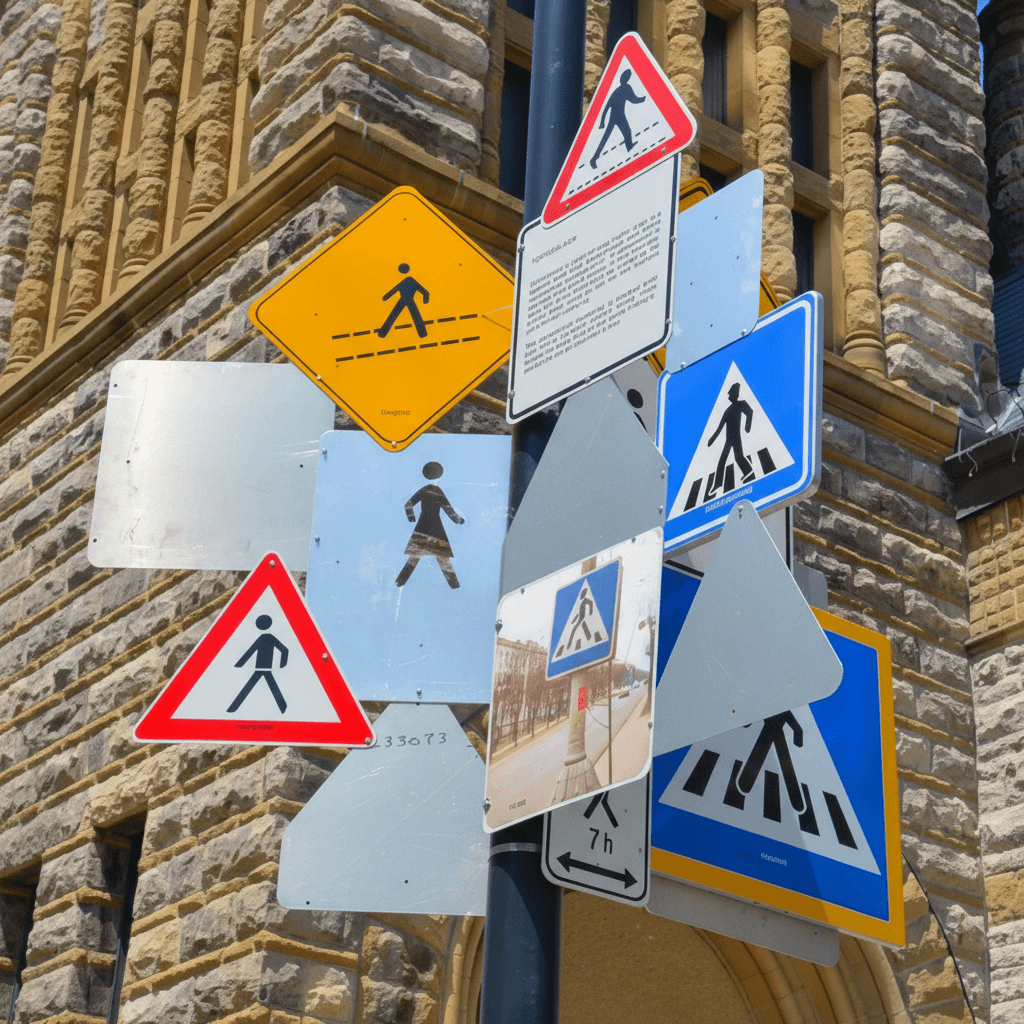
Today, I found myself staring at a crosswalk sign, waiting for a little green figure to tell me I could cross the street. It struck me—here I was, a grown adult, obediently waiting for a blinking cartoon figure. But it's not just the crosswalk. It's the bike lane, the car speeding past, the sidewalk I'd walked to get there, the bus stop on the corner. Everywhere, a web of infrastructure dictates where to go, when to stop, how to move.
We like to think we’re free. After all, mobility is freedom, car commercials showing us open highways, plane ads promising new adventures, and train timetables assure us we can be anywhere on time. But here’s the thing: we’ve never been less free. Every move we make is dictated by signs, fines, signals, and schedules. Cross here. Stop there. Merge now. Every step choreographed by an invisible rulebook that doesn’t take kindly to improvisation.
Take a moment to look around any urban environment, and you’ll see it: roads, highways, bridges, parking lots, bike paths, traffic lights, crosswalks, speed bumps, overpasses. Cars dominate, they rule the streets, and if you’re not in one, you’re an afterthought. A pedestrian is an obstacle, a cyclist a nuisance. Vulnerability creating a literal and social divide. It’s a kingdom of machines, and we’re just visitors, dodging and weaving to stay alive.
This infrastructure, as advanced as it looks, comes at a cost. It’s built for speed, for economic productivity, for the endless logistics of our globalized world. It keeps supply chains humming and commutes moving (mostly). But it’s expensive and therefor fragile. In the U.S., crumbling bridges and potholes are the stuff of everyday life—safety hazards born of underfunded maintenance. In Chicago, I watched sinkholes swallow cars after winter snowmelt. The Netherlands is struggling to modernize its railway system and trains, highspeed trains going at 80 km/h, ticket prices rising and potential suspension of the Eurostar connection between London and Amsterdam. High-tech infrastructure promises smooth sailing but delivers cracks in the asphalt.
And let’s just admit it’s unsightly. Cities and towns blanketed with concrete and asphalt, streets covered in signs, littered with parked cars. We’re immersed in a landscape of function over form, of technology over humanity. It’s no wonder I loved rollerblading when I was younger. Suddenly, all that rigid, oppressive infrastructure became a playground. It felt good to flip the script—to take back a bit of freedom, even if just for a moment.
But what happens when the system breaks? When roads crack and bridges fail? History gives us a clue. After the fall of the Roman Empire, their roads remained in use for centuries, serving as vital transport routes in medieval Europe. But without organized maintenance, they slowly crumbled, making it harder to move goods and people across the landscape. Carts and carriages, dependent on smooth roads, became liabilities in a world that could no longer sustain them.
Meanwhile, in China, they had a simpler solution. The Chinese wheelbarrow—a single-wheeled cart that could be pushed or pulled—didn’t need roads. It could navigate narrow footpaths. Where the Roman infrastructure relied on centralized power and upkeep, the Chinese wheelbarrow thrived on simplicity and independence. It was a tool for people, not empires, and it worked as long as you had a path—any path.
There’s a lesson here. High-tech infrastructure, for all its efficiency, creates dependence. Roads require governments, maintenance budgets, and entire industries. Simpler systems, on the other hand, are resilient. They don’t need much to keep going. And they shape the world differently. Where highways encourage sprawling cities and centralized hubs, footpaths and simple tools create smaller, self-sufficient communities. They slow life down, bringing it back to a human scale.
Picture this: Coming home from work, you park your shared electric car at the edge of your neighborhood, where it charges from community solar panels. You wind down tree-lined walkways that invite a slower pace, passing communal gardens as you decompress. On your way home, you pick up fresh fruit from the local market—a vibrant space that once held parking spots. Shared carts and cargo bikes handling local deliveries and daily needs zip past. This thoughtful infrastructure creates room for community and prioritizes human connection and conversation over speed and machinery.
Picture a neighborhood where roads and parking spots have given way to tree-lined walkways and communal gardens. Public transport and shared electric cars bring you to its edge, but the neighborhood itself begins where motors end. Wide, welcoming paths invite walking and biking, with communal electric vehicles standing ready when needed. Shared carts and cargo bikes handle local deliveries and daily needs. This thoughtful infrastructure creates a slower pace of life, prioritizing human connection and conversation over speed and machinery.
Or imagine this: a neighborhood transformed by "unpaving"—streets replaced by garden paths winding between homes. With muscle-powered mobility and transportation like the Chinese wheelbarrow, the space becomes quieter, greener, healthier, and more intimate. Water soaks naturally into the ground, and underground utilities become easy to access. These paths don't merely connect homes—they nest them in a natural landscape that invites nature, combats heat and flooding, and brings people closer together in a softer, gentler rhythm of life.
And then there’s the ultimate freedom: leaving the paths altogether. In cities, it’s impossible. Even in the Netherlands’ national parks, you’re told where to walk, where not to stray, how to stay within the lines. Nature here, is too fragile, too scarce, to handle us wandering freely.
But in places where wildness still exists—real wildness—you can step off the path. The moment you do, you leave society behind. The signs disappear. The rules vanish. Suddenly, you’re not being told where to go or how to move. You’re in the wilderness, where there are no maps, no schedules, no safety nets. It’s terrifying, but exhilarating.
In that wildness, you find something cities and highways will never offer: true freedom. You can explore, roam, and discover. There are no fines, no signs, no fences. You surrender the illusion of control, but in return, you get something better—a connection to the natural world, to the land as it is, not as we’ve shaped it.
We’ve built a world that moves fast, but at what cost? Roads, rails, and runways make the modern world possible, but they’ve also taken something from us. They’ve taken simplicity, self-sufficiency, and the thrill of freedom. Lets find more time to slow down. To take the long way. To step off the path.